


Share this to




Revenue leaders are under pressure to grow without creating fragility. Targets rise, buying cycles stretch, and boards want confidence rather than optimism. AI is often positioned as the answer, yet many CROs remain unconvinced. Tools are active, dashboards are busy, and outcomes feel unchanged.
The issue is not capability. It is how AI is introduced into the commercial system. When insight is disconnected from ownership, rhythm, and consequence, it becomes noise. When it is grounded in clear commercial intent, it becomes signal.
This is where the FLAIR approach used by Six & Flow matters. Not as theory, but as a practical way to make AI useful for revenue leadership.
This post explains how FLAIR applies to the CRO role, why most AI initiatives fail to change revenue outcomes, and what needs to be true for AI to support growth with control.
Why AI rarely changes revenue behaviour
Most revenue teams already have more data than they can act on. Adding AI increases volume, not clarity.
Three problems show up repeatedly.
First, AI is introduced without a defined commercial job. It scores deals, flags risk, or predicts outcomes, but nobody agrees what should change as a result. Sales leaders revert to judgement. RevOps defends the model. Nothing moves.
Second, insight arrives outside the revenue rhythm. It lives in a dashboard or weekly email. Under pressure, it is ignored. Over time, trust erodes.
Third, ownership is unclear. When AI output challenges a forecast or account plan, who decides what to do. Sales management, RevOps, or leadership. Without clarity, the safest option is inaction.
These are operating issues, not technology issues.
What CROs should expect AI to do
AI should not replace sales judgement. It should sharpen it.
For a CRO, the most valuable AI outputs are early signals that humans tend to miss or rationalise away.
- Where pipeline risk is increasing despite headline coverage.
- Which deals behave unlike others at the same stage.
- Which accounts show early signs of contraction before renewal conversations begin.
- Where activity looks busy but progress is weak.
These signals matter because they allow earlier intervention. Earlier intervention is where revenue leaders create advantage.
If AI cannot be linked to action, it is not worth the attention it demands.
FLAIR as a commercial discipline
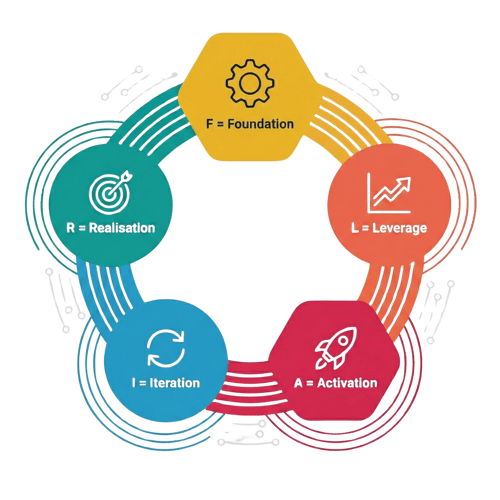
FLAIR provides a sequence for making AI commercially useful without overcomplicating the organisation.
Foundation is where most revenue teams underestimate the work required. AI depends on stable definitions. Pipeline stages, qualification criteria, account ownership, and lifecycle status must mean the same thing across teams. If these shift to meet local sales needs, AI output will be inconsistent. Humans adapt. Models do not.
Foundation also includes leadership behaviour. If CROs and their teams do not trust the same data they expect AI to analyse, adoption will stall.
Leverage is about choice. Not every part of the revenue engine needs intelligence. CROs should decide where AI can materially change outcomes. Forecast confidence, renewal risk, and exception detection are common starting points. Fewer use cases, executed well, outperform broad experimentation.
Activation is where value is won or lost. Insight must sit inside the revenue operating rhythm. Forecast calls. Account reviews. Pipeline governance. If AI highlights risk, there needs to be a defined response. Who reviews it, when, and what happens next. Optional insight will always be ignored.
Iteration recognises that revenue behaviour changes. Sales motions evolve. Pricing shifts. Markets tighten or loosen. AI logic needs review to stay relevant. Treating it as fixed undermines trust.
Realisation is when AI becomes expected, and when account plans feel incomplete without it. It's also when pipeline discussions reference it naturally. At that point, AI stops being debated and starts being used.
What this looks like in practice
In Financial Services, CROs often manage long sales cycles and complex suitability considerations. AI can surface early hesitation or inconsistency in prospect behaviour. When reviewed alongside pipeline governance, this improves forecast confidence and reduces late stage surprises.
In Professional Services, growth is constrained by delivery reality. AI that highlights misalignment between pipeline promises and delivery capacity helps CROs protect margin as well as revenue. The key is linking insight to account leadership, not leaving it with operations.
In Tech and SaaS, lifecycle revenue dominates. AI that flags adoption friction or renewal risk early gives CROs time to intervene. This only works when lifecycle definitions are stable and shared across sales and customer teams.
Across sectors, the same rule applies. AI reflects the commercial truth it is given. It does not fix weak discipline.
The CRO role in making FLAIR work
CROs do not need to own data platforms or models. They do need to set expectations.
First, be explicit about what AI is for. Decide which decisions it informs and which it does not. Ambiguity creates frustration.
Second, insist on stable commercial definitions. If a stage or metric matters to forecast confidence, it needs to be enforced consistently.
Third, embed AI into revenue governance. If it does not appear in meetings that matter, it does not matter.
Lastly, challenge insight constructively. AI should be questioned, not dismissed. Debate builds trust when it is grounded in shared data.
A simple test for CROs
There is a practical way to assess whether AI is working for your revenue organisation:
If this insight made the forecast look worse, would we still act on it?
If the answer is no, the issue is not accuracy. It is alignment.
AI that only feels useful when it supports optimism is not supporting growth. It is masking risk.
Closing view
FLAIR is not about moving faster or adding more technology. It is about creating the conditions where AI supports better commercial judgement.
For CROs, the opportunity is clear. Earlier signal. Fewer surprises. More controlled growth.
The risk is equally clear. AI introduced without discipline becomes noise and erodes trust.
When the operating model is ready, AI earns its place in the revenue conversation. When it is not, the smartest tools in the world will not change outcomes.




Unleash the power of RevOps
Maximize revenue and sales today.
Begin experiencing faster growth by managing revenue generation cross-functionally. Download the complete guide to RevOps to learn how you can align your teams and scale revenue.
