


Share this to



-1.svg)
Most mid-market leaders I speak to are not asking whether AI works. They can see it working in pockets. Someone has a helpful assistant for meeting notes, a dashboard that flags churn risk, or a sales tool that writes half-decent follow-ups.
The real question is simpler and harder: can the business rely on it?
From a CFO perspective, AI only becomes interesting when it changes an outcome you can defend in a board pack. Not an anecdote. Not “the team feels faster”. Measurable shifts in forecast accuracy, cycle time, cost-to-serve, control, and risk.
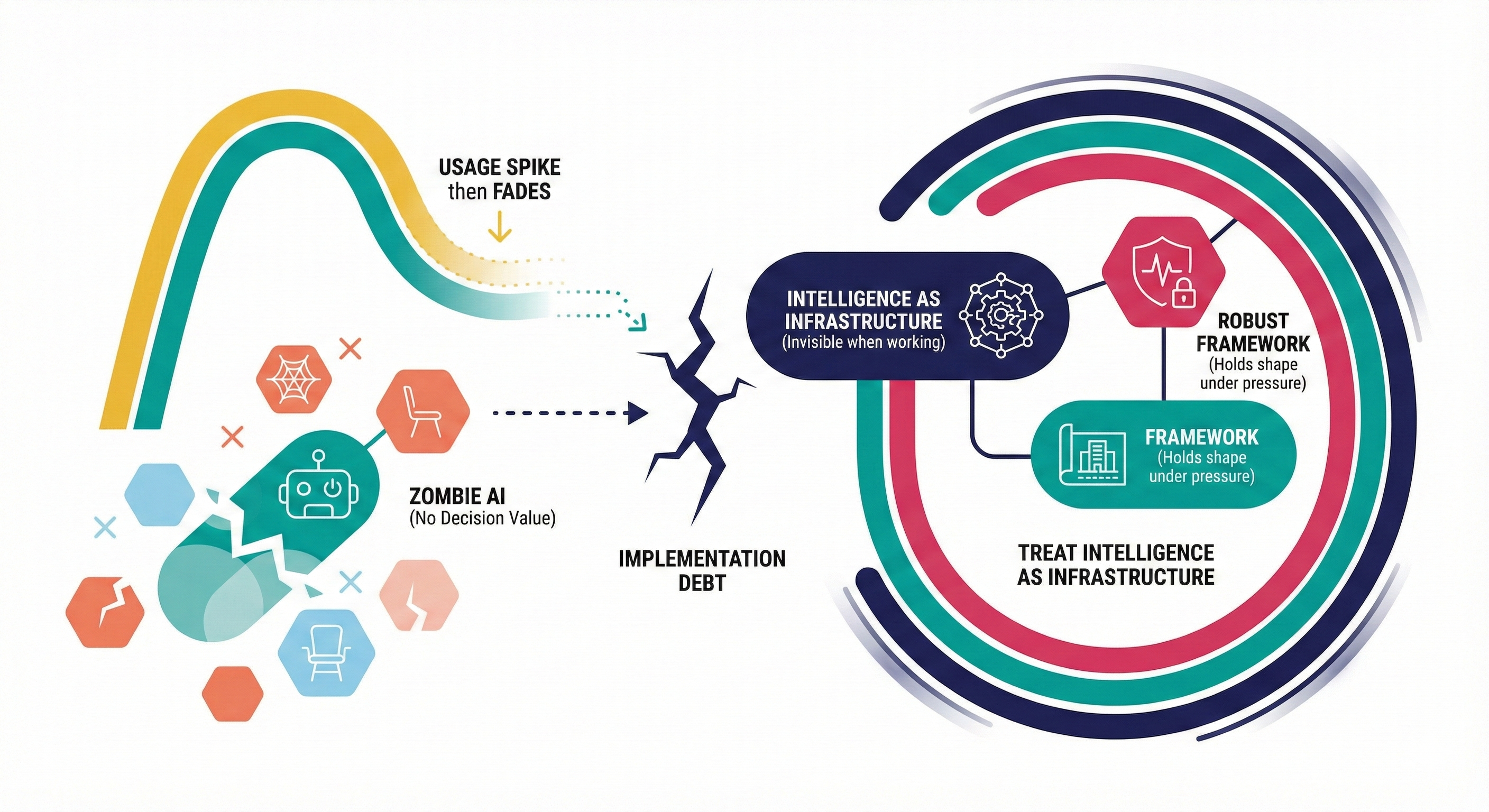
The uncomfortable truth is that most RevOps and AI programmes fail quietly. Usage spikes, then fades. Outputs drift out of date. People stop trusting what they are seeing. You end up with something that technically exists but no longer informs decisions, what we call “zombie AI”.
This is not a model problem. It is an operating model problem.
If you lead finance, operations, or revenue in a 100 to 2,000 person business, here is the practical way to think about RevOps and AI so it compounds instead of stalling.
What RevOps and AI should actually mean
RevOps is meant to do three things well:
-
Make revenue performance measurable
-
Make revenue execution repeatable
-
Make revenue decisions faster and safer
AI should improve those same three things, but only if it is held within a structure that keeps it accurate, governs it, and ensures adoption.
If AI is not wired into decision loops, it will become a sideshow. If it is wired in without a solid foundation, it will create risk.
The fastest path to disappointment is automating chaos.
Why CFOs should be sceptical of “more use cases”
Many organisations respond to the lack of impact by doing more pilots. They add more tools. They run more experiments.
That makes the problem worse.
A longer list of use cases is not a strategy. It increases variance, governance workload, and training burden. It also makes it harder to compare ROI because each pilot measures success differently.
A better target is this: fewer, higher-quality decision loops.
Examples of decision loops that matter in RevOps:
-
Forecast commits: what changed, why, and what the confidence is
-
Pipeline hygiene: which deals are inflating the forecast and why
-
Lead routing: which leads should be prioritised and what happens next
-
Renewal risk: which accounts need intervention and what action is required
-
Revenue leakage: where process and data errors are costing money
AI is valuable when it tightens those loops or removes steps permanently, not when it creates a clever output that sits in a Slack channel.
The CFO test: three questions before you fund anything
If you want to separate theatre from value, use these questions.
-
What decision will change because of this?
If the answer is “the team will have insights”, push harder. Which meeting? Which decision? Who will act differently?
-
What data is this decision built on, and is it stable enough?
If your CRM fields are inconsistent, your lifecycle stages are debated weekly, or your definitions vary by region, your AI output will be unstable. FLAIR calls this the Foundation problem: data, systems, process, ownership, and culture need to be solid enough to “hold what you are about to build”.
-
How will you measure adoption, not just output quality?
An assistant can be accurate and still useless if nobody uses it. Adoption needs a real metric, a cadence, and an owner.
A practical approach: apply FLAIR to RevOps and AI
If you want AI to survive beyond the initial excitement, treat it as infrastructure, not a feature.
FLAIR is the structure we use to make that real: Foundation, Leverage, Activation, Iteration, Realisation.
Here is what that looks like in RevOps terms.
Foundation: fix what AI will depend on
This is where most teams try to skip ahead. Don’t.
Foundation is about realism: are your data, systems, process, ownership, and culture stable enough to sustain intelligence once it exists?
In RevOps, that means:
-
Standardise the handful of CRM fields that drive reporting and workflow, then enforce them
-
Confirm system stability and integration health (CRM, marketing automation, support, finance)
-
Lock the definitions that shape your funnel and forecast (stages, lifecycle, SQL, pipeline categories)
-
Assign ownership, not “shared accountability”. Someone must be on the hook for data integrity and logic drift
-
Make sure leadership actually uses the outputs, otherwise nobody else will
If you do nothing else, do this. It is the difference between compounding value and a year of rework.
Leverage: choose use cases with the right economics
Leverage is how you avoid “use case bingo”. It is a prioritisation discipline.
FLAIR’s Leverage matrix scores use cases across impact, feasibility, adoption potential, time-to-value, and leadership alignment.
For a CFO, the key is portfolio balance:
-
Quick wins that build confidence and free capacity
-
Strategic bets that materially shift revenue performance
-
Conditional opportunities you park until foundations improve
This is where you align finance, revenue, and operations around what value means, instead of debating it mid-project.
Activation: ship with ownership and behaviour change, not just a demo
Activation is where most AI projects die, even after good build work.
If you ship an assistant without an owner, a training plan, and a clear behavioural expectation, it will become optional, then forgotten. Activation explicitly calls for ownership, change management, and governance to be designed in from day one.
In RevOps, Activation should include:
-
A named business owner (not just IT or “RevOps”)
-
A usage moment (for example, “this output is reviewed in the Monday forecast call”)
-
A feedback loop that is visible and simple
-
Guardrails for regulated industries (especially financial services)
Iteration: run prompts and logic like code
AI drift is real. Processes change, data changes, customers change.
Iteration is the habit of maintaining AI as a living product: versioning, regression testing, evaluation cadence, and human review.
If you are in financial services, this is also where control and auditability stop being scary and start being routine. The white paper makes the point that governance has to be continuous because AI is dynamic; you cannot “govern and forget”.
Realisation: make intelligence part of the operating rhythm
Realisation is where the CFO actually sees compounding returns.
It is not about rolling out more assistants for the sake of it. It is about embedding intelligence into governance, language, and routine, then scaling through networks, not heroics.
When this is done well, AI becomes expected in key meetings and reports, not optional.
What outcomes to expect, and what to measure
If you want AI and RevOps to pass the credibility test, measure outcomes that show up in finance and operations.
Examples:
-
Forecast accuracy: variance reduction, confidence scoring, fewer late surprises
-
Sales cycle time: reduction in stalled deals, faster stage progression
-
Cost-to-serve: reduced manual reporting, fewer escalations, better routing
-
Data quality: reduction in missing critical fields, fewer exceptions
-
Adoption: weekly active users of assistants, usage in core meetings, satisfaction scores
The point is not to prove AI is clever. The point is to prove the business is learning faster than it changes.
FAQs
What is RevOps AI, in plain English?
It is using AI to improve the speed and quality of revenue decisions across marketing, sales, and customer success by using reliable data and repeatable processes, not one-off automation.
Why do AI pilots fail even when the output looks good?
Because adoption fades, data drifts, ownership is unclear, and there is no operating rhythm to keep the system maintained. This is the “quiet failure” pattern the FLAIR paper describes.
What should a CFO ask for before approving budget?
A clear decision loop, a short list of foundational data requirements, an owner, an adoption metric, and a governance plan that covers ongoing iteration.
How do we avoid AI becoming a compliance headache in financial services?
Bake governance into the build, not as a retrofit. Maintain versioning, audit trails, and evaluation cadence as part of normal operations.
A simple next step
If you want to move from pilots to something your organisation can depend on, start with a Foundation assessment. Score data, systems, process, ownership, and culture, then prioritise use cases through a proper value lens.
That is the difference between “we tried AI” and “AI changed how we run the business”.




Unleash the power of RevOps
Maximize revenue and sales today.
Begin experiencing faster growth by managing revenue generation cross-functionally. Download the complete guide to RevOps to learn how you can align your teams and scale revenue.
