HubSpot vs Salesforce TCO Comparison 2026: the operating model argument.
Most CRM decisions focus on licence cost.
The real cost is what it takes to run the platform every day for five years. Internal teams, managed services, and third-party tools all come into play.
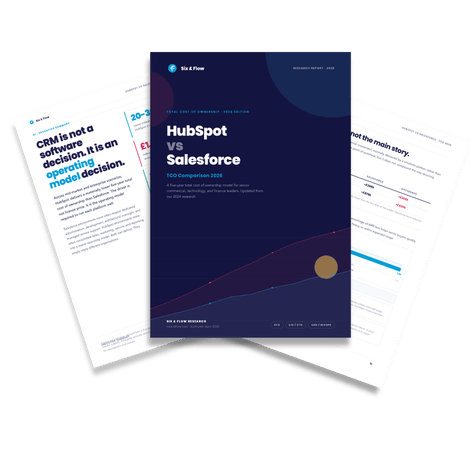
What this report actually covers (and why it matters)
Most CRM comparisons stop at licence price. This one goes further.
The 2024 version of this research looked at team structures. It was useful but incomplete. Licence pricing has grown more complex, AI and data costs have become material, and senior leaders are asking harder questions about the long-term cost of running revenue technology.
This 2026 update rebuilds the comparison from scratch around a five-year total cost of ownership model. It covers software licences, implementation, internal staffing, vendor support, third-party managed services, ecosystem costs, and data volume modelled across mid-market, enterprise, and complex enterprise scenarios.
The conclusion still leans toward HubSpot. But the argument is stronger because it is built on a more complete picture. Where the evidence is genuinely contested, we say so.
Create a CRM decision that your finance and technology leadership can defend.
No vendor spin. A planning model built for CFOs, CIOs, and RevOps leaders who need numbers they can stand behind.
- Five-year TCO figures across mid-market, enterprise, and complex enterprise scenarios
- A breakdown of where the cost gap actually comes from, it is not the licence
- Internal staffing ranges for both platforms, by company size and operating model
- Managed services and partner support costs modelled as a real cost layer, not a footnote
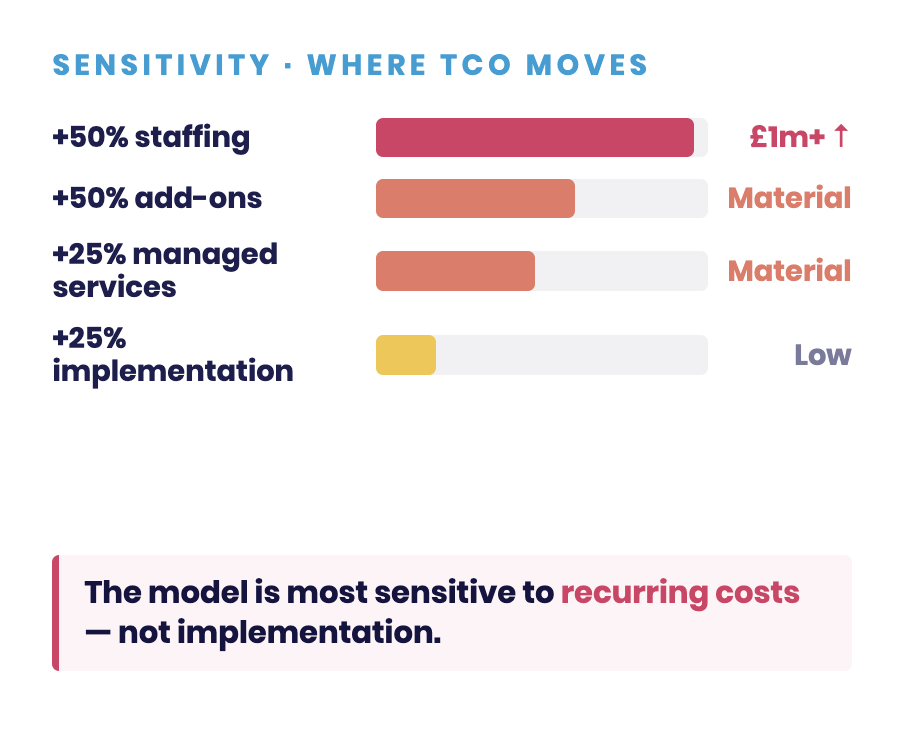
- Sensitivity analysis showing which variables move the number most
- Role-specific implications for CFO, CIO/CTO, and CRO/RevOps audiences
- A six-step buying discipline you can apply before signing anything
Download the 2026 TCO Report
Understand the full five-year cost of HubSpot versus Salesforce, and which operating model fits your organisation.
The difference is labour, not licences
Why the licence quote is the least useful number in the comparison.
Salesforce licence pricing can look competitive, particularly when significant discounts are applied at enterprise scale. The challenge is that the platform typically requires more people and process around it to operate well.
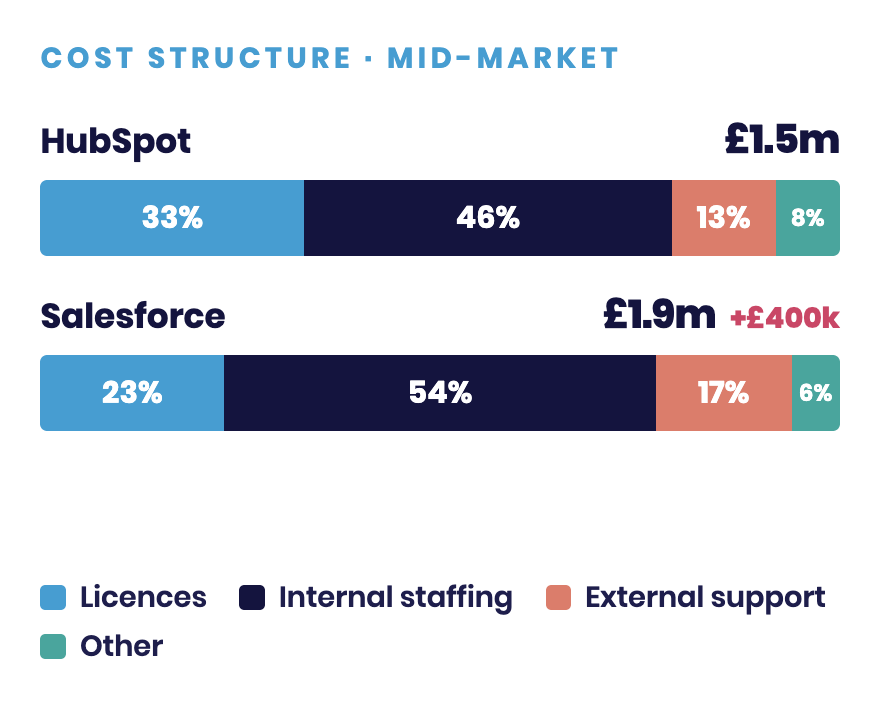
In the mid-market scenario, internal staffing accounts for 54% of Salesforce's five-year cost versus 46% for HubSpot. At enterprise scale, the pattern holds. The gap is not what you pay for the software. It is what you pay to run it.
What the numbers show
Across all three modelled scenarios, mid-market (80 to 150 users), enterprise (250+ users), and complex enterprise, HubSpot delivers a materially lower five-year total cost of ownership. The indicative figures:
- Mid-market: HubSpot £1.5m vs Salesforce £1.9m, a 21% difference
- Enterprise: HubSpot £4.0m vs Salesforce £5.5m, a 27% difference
- Complex enterprise: HubSpot £5.0m vs Salesforce £7.2m, a 31% difference
How it works in practice
Rather than comparing a licence quote in isolation, the 2026 model breaks cost into five distinct layers: licences, implementation, internal staffing, vendor support, and third-party ecosystem costs, each modelled separately across a five-year horizon.
This makes the real economics visible. You can see:
- Which cost layer is driving the gap
- How recurring cost compounds year on year
- Where Salesforce's operating model requires additional structure
- Which variables move the number most in your specific scenario
Why it matters
- Every £100k of annual operating cost difference adds £400k to five-year TCO
- Implementation is a one-off; staffing and support compound every year
- Most buying processes over-index on visible cost and under-index on embedded operating cost
- Negotiating £100k off implementation does not help if the platform costs £150k more per year to run
Download the TCO Report
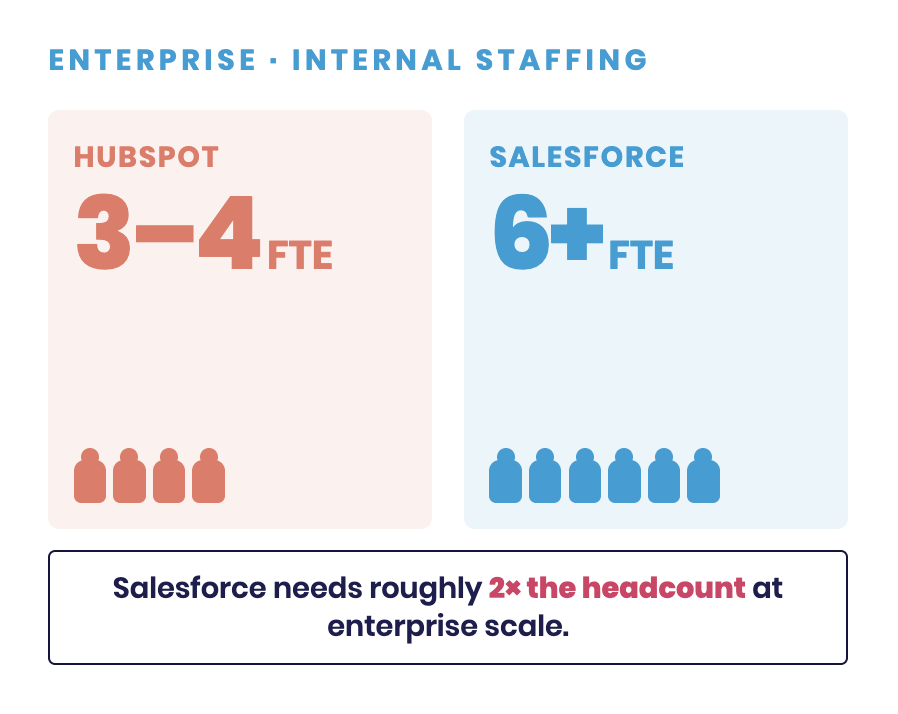
Salesforce needs roughly twice the internal headcount at scale
The staffing picture is the single largest driver of total cost of ownership.
Both platforms require internal ownership. The difference is how specialised those roles become as the organisation scales.
HubSpot operating models tend to distribute ownership across RevOps, marketing operations, and sales operations , generalist roles that sit inside the commercial team. Salesforce environments more frequently require dedicated administrators, developers, solution architects, and integration specialists.
What the model shows
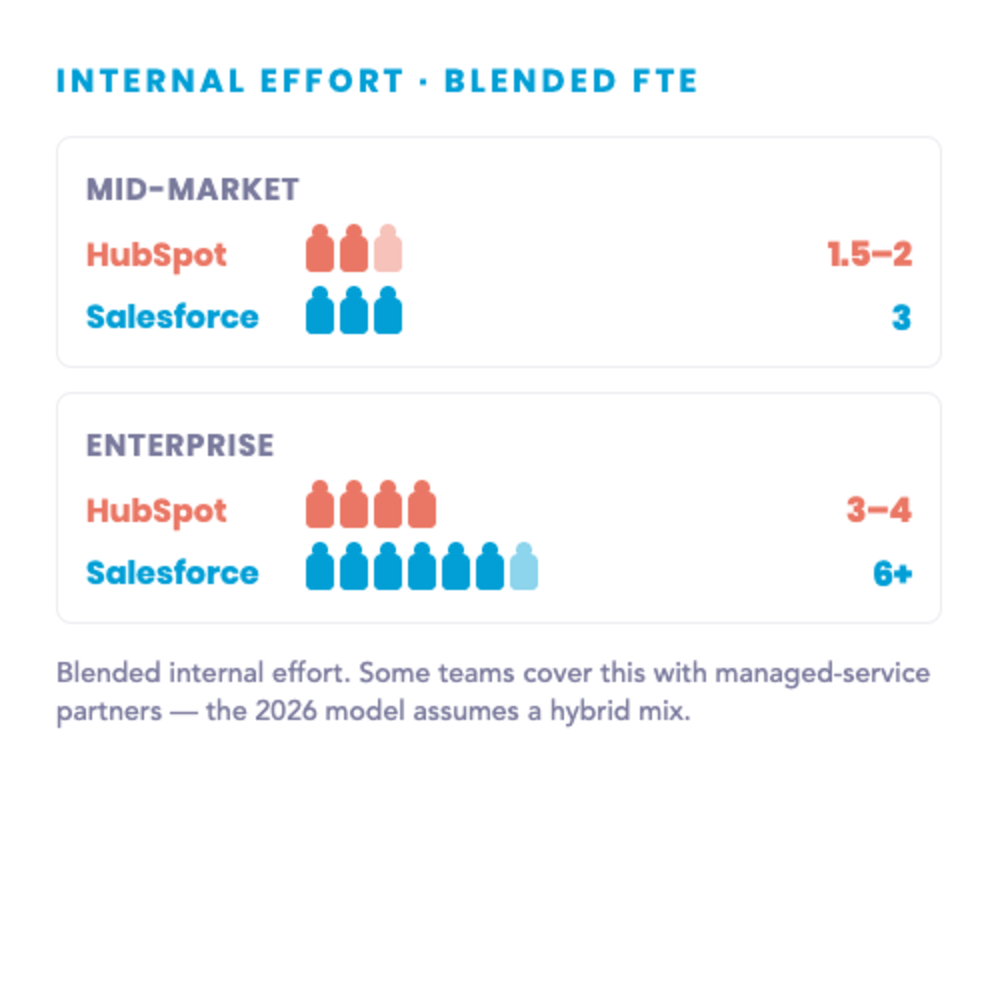
Blended internal FTE estimates by scenario:
- Mid-market: HubSpot 1.5 to 2 FTE vs Salesforce 3 FTE
- Enterprise: HubSpot 3 to 4 FTE vs Salesforce 6+ FTE
These are not exact headcount figures; they represent blended internal effort. Some organisations cover this through managed service partners rather than direct hires. The 2026 model accounts for that explicitly, using a hybrid assumption rather than adding partner cost on top of a full internal team.
How it works in practice
Rather than relying on job title counts as a proxy for cost, the 2026 model uses blended FTE estimates that account for the mix of internal roles, managed service partners, and fractional support most organisations actually use.
You can see:
- How ownership is distributed differently across each platform
- Why outsourcing to a partner changes where cost sits, not the total
- How staffing requirements scale as the organisation grows
- Where the 2x FTE difference materialises most
Business impact
- Specialist roles attract specialist salaries, the FTE difference compounds quickly
- Outsourcing to a partner changes where the cost sits, not the total
- Salesforce cost increases materially with architectural complexity, custom objects, and bespoke workflows
- The commercial question is whether the additional flexibility is worth the additional operating burden
Download the TCO Report
Implementation is important (but it is not the main story)
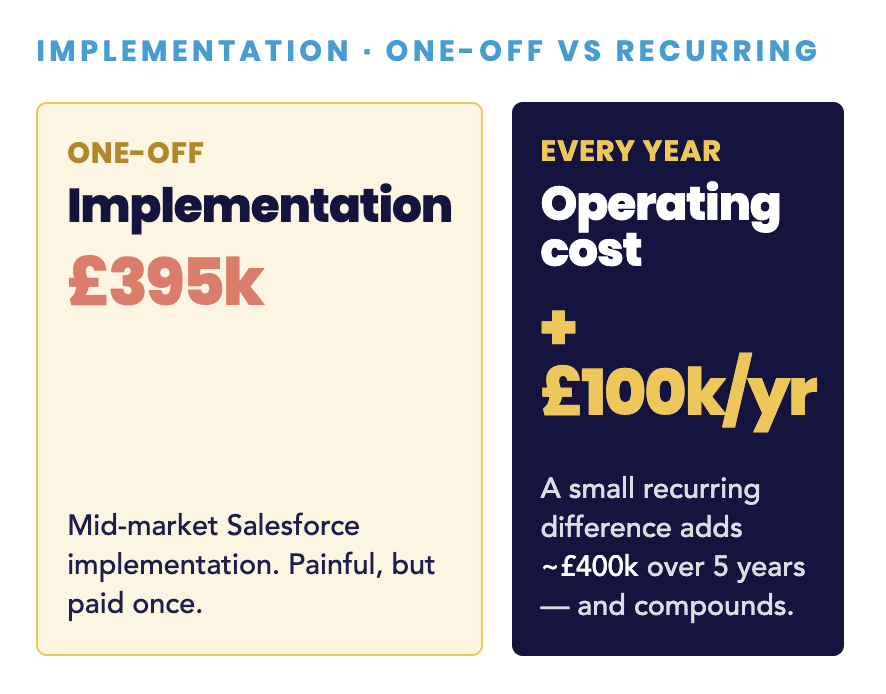
One-off cost and recurring cost behave completely differently. Most buying processes treat them the same.
Implementation cost is visible, heavily negotiated, and often the focus of the initial commercial conversation. It also happens once. Recurring operating costs happen every year for the life of the platform.
Blending the two into a single number, as many CRM business cases do, hides the real economics of platform ownership over time.
Indicative implementation ranges
Based on modelled assumptions at 2026 partner rates:
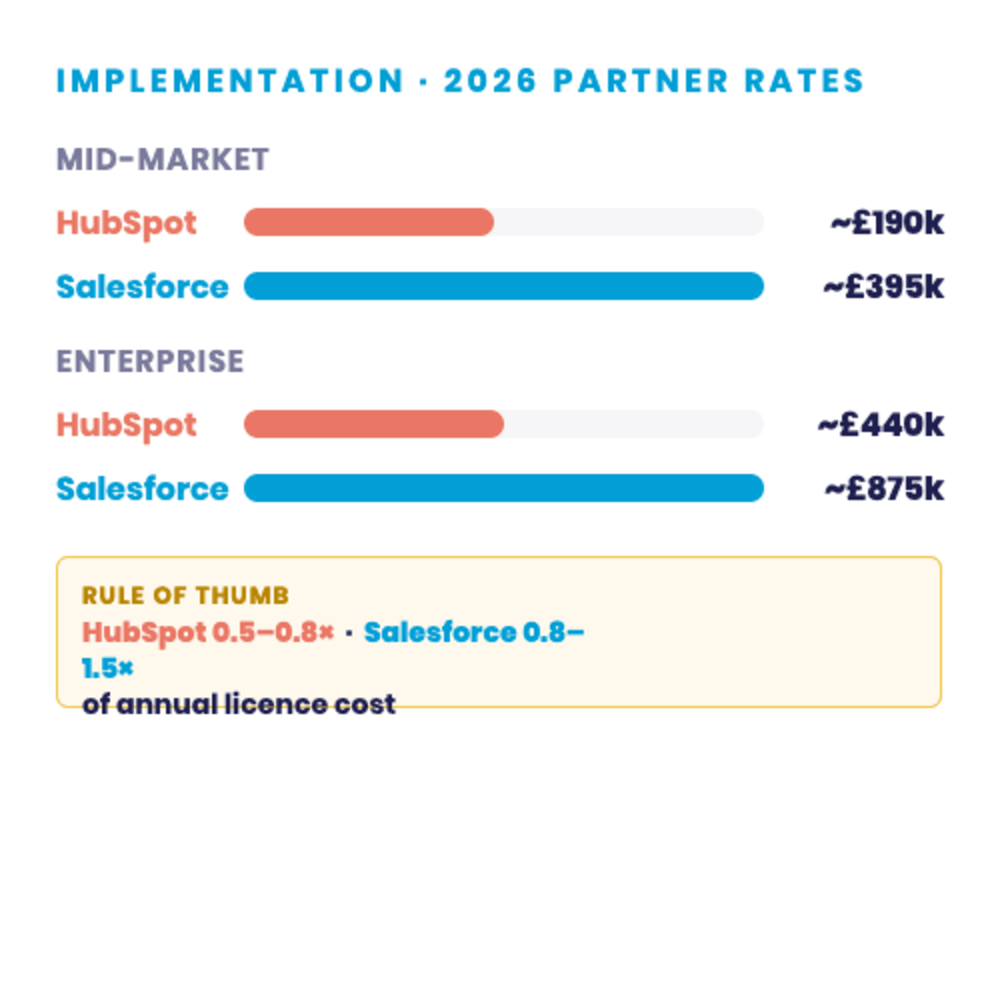
- Mid-market: HubSpot approximately £190k vs Salesforce approximately £395k
- Enterprise: HubSpot approximately £440k vs Salesforce approximately £875k
As a rule of thumb, HubSpot implementation typically runs at 0.5x to 0.8x annual licence cost. Salesforce runs at 0.8x to 1.5x. The main cost drivers are data quality, integration depth, and process complexity, not the platform itself.
How it works in practice
Rather than presenting implementation as a single blended figure, the model separates one-off project cost from recurring operating cost and stress-tests each independently.
You can see:
- How data quality, integration depth, and process complexity drive implementation cost
- Why the implementation gap between platforms narrows or widens by scenario
- How a £200k implementation saving can be reversed by a £150k annual operating differential
- What a defensible implementation budget looks like relative to your annual licence spend
Business impact
- A clean, focused rollout costs a fraction of a complex multi-region programme on the same platform
- Poor data quality is the single largest implementation cost driver on either platform
- Implementation overruns are painful but finite; operating model misfit is paid for every year
- Build a five-year model, not a first-year one, the real economics only become visible over time
Third-party and ecosystem costs are the most underestimated line item
Most buying processes spend too much time on visible cost and not enough time on what sits underneath it.
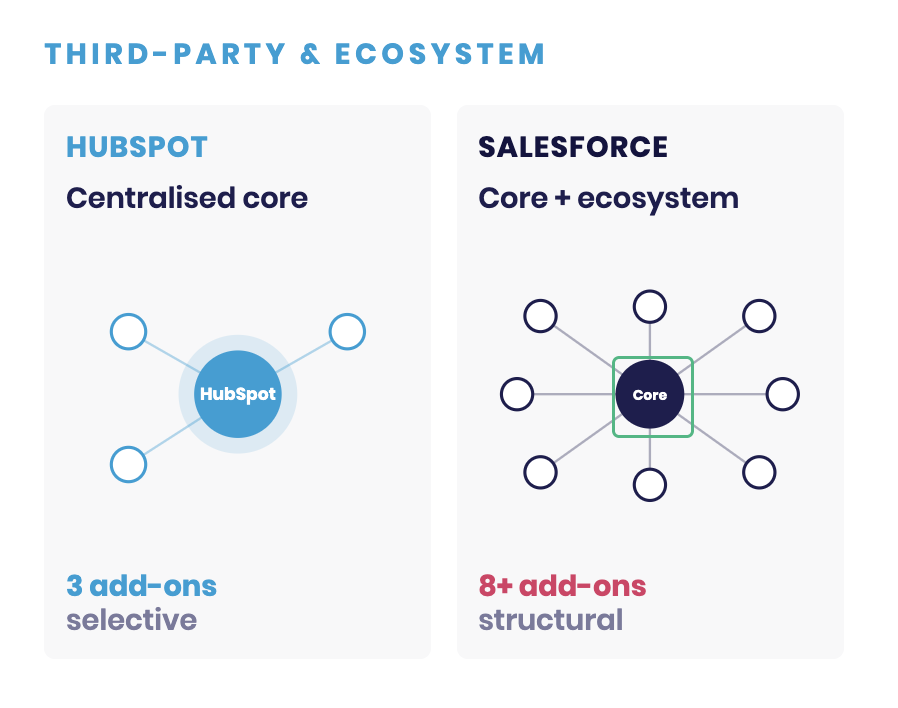
Both platforms rely on broader ecosystems. It would be misleading to suggest HubSpot operates without third-party apps or that Salesforce always requires extensive add-ons. The reality is more nuanced, but the patterns are consistent.
Salesforce environments more frequently depend on AppExchange tools, middleware, integration platforms, document tools, and industry-specific applications. The more fragmented the ecosystem, the more expensive and time-consuming the operating model becomes.
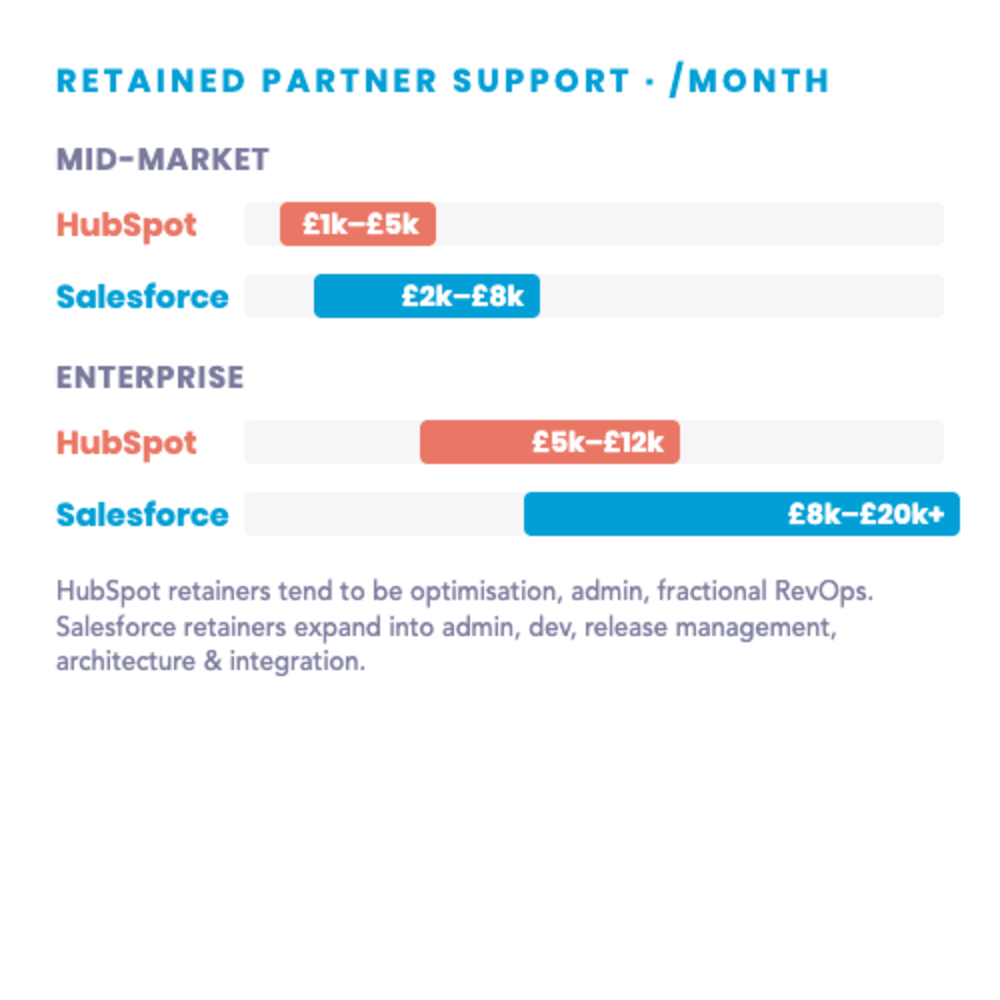
Typical monthly retained partner support
Mid-market retained support ranges:
- HubSpot: £1k to £5k per month
- Salesforce: £2k to £8k per month
Enterprise retained support ranges:
- HubSpot: £5k to £12k per month
- Salesforce: £8k to £20k+ per month
HubSpot retained engagements tend to start as optimisation, admin support, and fractional RevOps. Salesforce retained engagements more frequently expand into specialist areas such as administration, development, release management, architecture, and integration support.
How it works in practice
Rather than treating partner support as a footnote, the 2026 model costs it explicitly, using a hybrid operating assumption, internal ownership with specialist partner support applied consistently to both platforms.
You can see:
- What does retained support realistically cost at mid-market and enterprise scale
- How Salesforce retainers tend to expand in scope over time
- Why ecosystem fragmentation creates compounding operational overhead
- How to avoid double-counting managed services against internal headcount
Business impact
- Ecosystem costs create ongoing operational overhead beyond the headline retainer
- Managing renewals, integrations, data sync, and permissions has a real labour cost
- Managed services change where the cost sits, not the total
- The hidden cost of fragmentation scales faster than most organisations anticipate
Download the TCO Report
When Salesforce is the right answer (and when it is not)
The report doesn't argue that HubSpot is universally better. It argues that the choice implies different organisations.
Salesforce is a mature, deeply configurable platform. Its economics are justified where the business genuinely requires custom architecture, complex enterprise integration, multi-cloud capability, or bespoke workflows at scale. The issue is not that Salesforce costs more; it is that buyers often choose it based on assumed enterprise norms rather than genuine complexity needs.
HubSpot's TCO advantage is strongest where RevOps can own and improve the platform without relying on engineering or architecture support. Where contact volumes, integration depth, or custom reporting scale rapidly, HubSpot's cost rises too.
The practical test
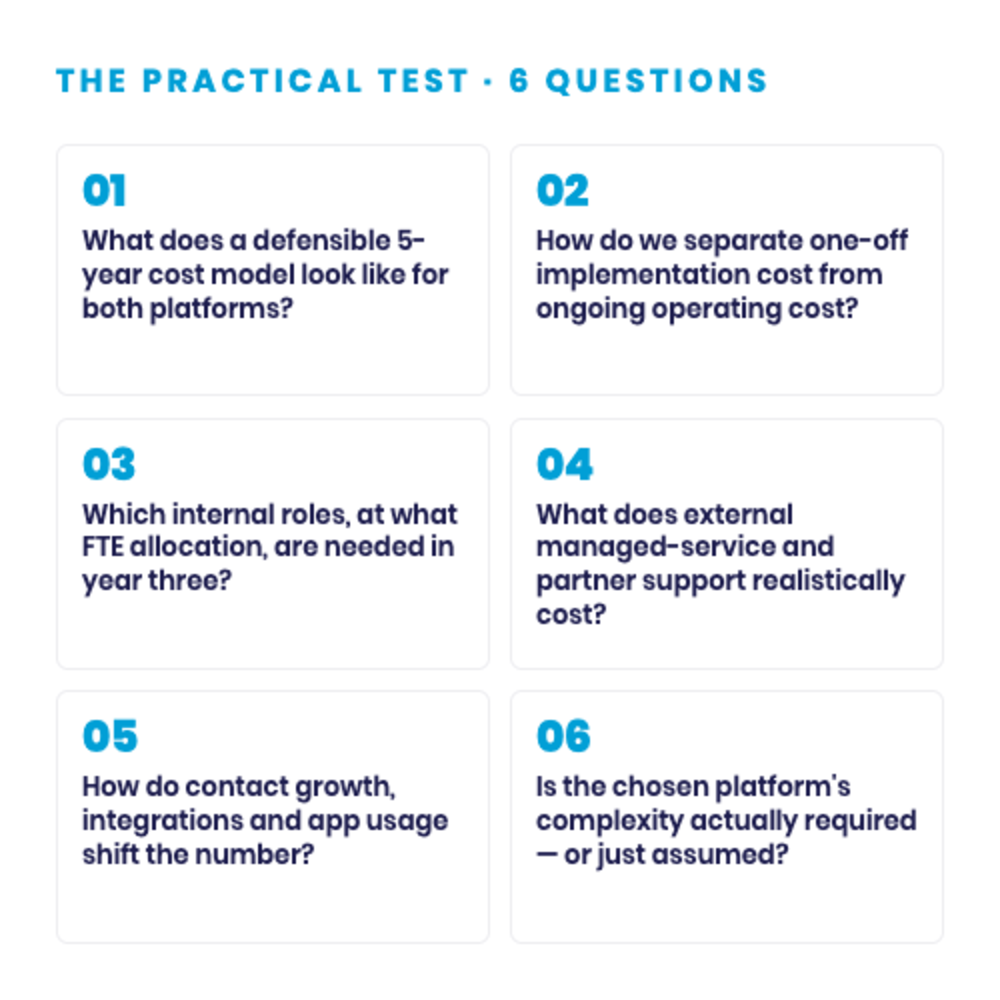
Before finalising a CRM decision, the 2026 report recommends working through six questions:
- What does a defensible five-year cost model look like for both platforms?
- What is the separation between one-off implementation cost and ongoing operating cost?
- What internal roles, at what FTE allocation, are required to run this well in year three?
- What does external managed service and partner support realistically cost?
- How do contact growth, integration volume, and app usage affect the number?
- Is the complexity of the chosen platform actually required or assumed?
How it works in practice
Rather than presenting a binary recommendation, the model is designed to be adjusted. Where you have better information about your own organisation, existing Salesforce expertise, known integration requirements, or unusual data volumes, the report shows you which assumptions to replace.
You can see:
- Which variables have the largest impact on five-year TCO
- Where HubSpot's cost advantage narrows under stress conditions
- How to frame the decision differently for CFO, CIO, and RevOps audiences
- What questions to ask vendors and partners before signing anything
Business impact
- The most expensive CRM systems are the ones built for problems you do not actually have
- Lower licence cost does not mean lower platform cost
- Higher licence cost may reduce operational burden, model it before assuming otherwise
- The best decision is the one where the operating model matches the organisation's real needs over five years
Download the TCO Report