


Share this to



Why CRM total cost of ownership is an operating-model question, not a licence line
A CRM total cost of ownership model is a five-year view of every meaningful cost to run your revenue platform: licences, implementation, internal staffing, support, and ecosystem. It shifts the decision from “Which quote is cheaper this year?” to “What operating model are we funding for the next five?”
Most senior leaders feel the discomfort here. Licence quotes are precise, branded, and heavily negotiated. The rest of the cost stack is hazy. Internal headcount is buried in cost centres. Managed services sit in a different budget. App subscriptions, integration tools, and data platforms are scattered across teams. The result is a CRM decision that looks disciplined on paper but hides most of the real economics.
Want to read the full report? You can download it here.
When you treat CRM as an operating-model decision, not just a software purchase, the picture changes. The question is no longer “Is Salesforce’s discount better than HubSpot’s?” but “How many people will we need to run this in year three, and what does that do to our five-year cost?” In our own modelling, a £100k recurring difference in operating cost adds roughly £400k to five-year TCO once you compound it across licences, staffing, support, and ecosystem.
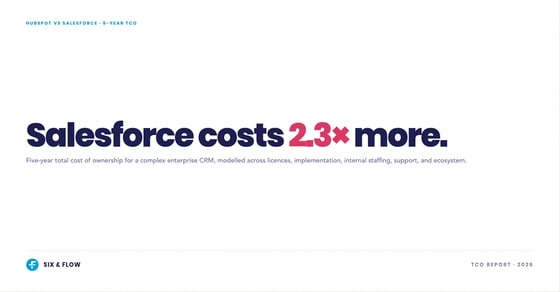
Independent analyses point in the same direction. One 2026 comparison found Salesforce environments can cost around 2.4x more over five years once you factor in consultant reliance and multi-cloud fragmentation, even when headline licence pricing appears competitive. Another study of a 25-person B2B sales team showed Salesforce’s all-in monthly TCO landing near $4,200 versus HubSpot at roughly $2,600, once implementation and app dependencies were included.
This is the core pain point for CFOs, CIOs, and CROs: it is straightforward to compare two licence quotes; it is much harder to compare two operating models. Without a structured TCO lens, organisations tend to overweight year-one implementation and underweight years two to five, where the real money is spent.
Reframing CRM as an operating-model choice also forces a more honest conversation about complexity. Salesforce’s strength is deep configurability and architectural flexibility. HubSpot’s strength is a more centralised, RevOps-friendly operating model. Both are valid, but they imply very different staffing profiles, partner dependency, and ecosystem footprints. Your TCO model is the tool that makes those trade-offs explicit instead of implicit.
The five-layer CRM cost model, with realistic HubSpot vs Salesforce examples
To build a credible five-year TCO view, you need a clear structure. A practical CRM total cost of ownership model breaks spend into five layers: software licences, implementation and onboarding, internal staffing, vendor support, and third-party ecosystem and managed services. Each behaves differently over time, and each looks different on HubSpot versus Salesforce.
Start with software licences. This is the most visible line item and the easiest to benchmark, but it is rarely the biggest driver of five-year cost. For a mid-market scenario with 80–150 users, a realistic model might show five-year licence plus core platform charges in the low seven figures for either platform. Discounts can move these numbers by 10–20%, but licence differentials alone usually do not explain large TCO gaps.
Implementation and onboarding is the next layer. This is a one-off external cost to configure, migrate, integrate, and go live. In practice, we see HubSpot implementations for mid-market and enterprise environments sitting at roughly 0.5–0.8x annual licence cost, while Salesforce often sits in the 0.8–1.5x range once integrations, custom development, and release management are factored in. On a programme with £550k of annual Salesforce licences, a 1.2x multiplier implies ~£660k of implementation; a comparable HubSpot rollout at 0.7x might land closer to £385k.
Internal staffing is where the real divergence appears. A mid-market HubSpot estate is commonly run by 1.5–2 FTE of blended RevOps and marketing ops talent. A comparable Salesforce estate of the same scale often requires around 3 FTE once you include administration, development, and solution architecture. At an all-in blended cost of, say, £90k per FTE, that 1–1.5 FTE delta adds £450k–£675k over five years before you touch any other line item.
Vendor support and managed services add another layer. Typical retained support ranges for HubSpot in mid-market might be £1k–£5k per month, primarily focused on optimisation, admin support, and reporting help. For Salesforce, it is not unusual to see £2k–£8k per month in ongoing partner support, especially where specialist development, release management, and integration governance are needed. Over five years, even a £3k per month difference in retained services adds £180k.
Finally, there is the ecosystem: apps, data tools, integration platforms, and industry add-ons. HubSpot’s centralised architecture often means fewer structural dependencies; apps tend to be selective enhancements. Salesforce’s core-plus-ecosystem pattern can deliver powerful industry solutions, but dependencies multiply. AppExchange packages at £25–£50 per user per month, integration middleware, and document automation tools all accumulate.
Put these layers together, and the pattern becomes clear. In a mid-market scenario, you might see a five-year HubSpot TCO model around £1.5m versus Salesforce at £1.9m, driven primarily by internal staffing and ecosystem overhead. At enterprise scale, the gap can widen to seven figures. The point is not that one number is perfect; it is that the structure exposes where cost really appears so you can challenge it.
How to turn your CRM TCO model into a board-ready, defensible decision
A CRM total cost of ownership model only adds value if it can withstand scrutiny from finance, technology, and revenue leaders. That means moving beyond a back-of-the-envelope spreadsheet to a disciplined, role-aware model that makes assumptions explicit and testable over a five-year horizon.
Begin by separating one-off and recurring cost. Implementation, data migration, and initial training belong in a distinct section. Licences, internal staffing, vendor support, and ecosystem costs sit in the recurring stack. This distinction matters because the board’s risk is not an implementation overspend; it is locking into an operating model that costs more every year than assumed.
Next, model internal staffing explicitly. Do not hide it as a generic percentage uplift. Name the roles you will need in year three: RevOps lead, CRM administrator, marketing ops manager, Salesforce developer, solution architect, data engineer, or equivalent. Assign realistic FTE fractions and blended rates. Then run scenarios: what happens if you need one more specialist head to manage a complex Salesforce multi-cloud architecture? What if a RevOps-led HubSpot model allows you to avoid that hire altogether?
Include managed services and ecosystem costs in the same detail. If you expect to rely on a partner for release management, integration monitoring, or AI agent configuration, model that as a recurring monthly retainer and stress test it upward by 25%. If your architecture assumes three critical third-party apps, price them per user and include implementation and support. Use external benchmarks from sources like Software Pricing Guide and independent CRM consultancies to sanity-check your ranges.
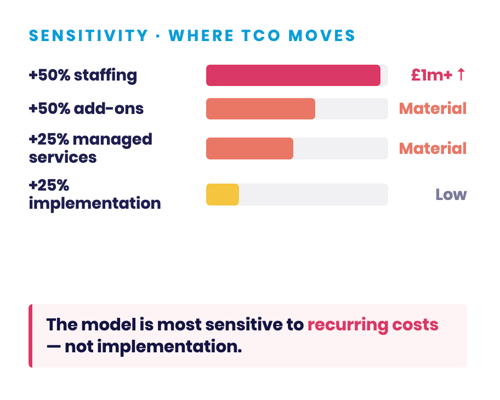
Once the structure is in place, build a simple sensitivity analysis. Test the variables most likely to move: contact volume, number of users, number of integrations, reliance on managed services, and staffing levels. A conservative test might be +50% contacts for HubSpot, +50% add-ons for Salesforce, and +25% managed services for both. Show your board how each variable affects five-year cost; the model will quickly reveal that recurring cost dwarfs implementation variance.
Finally, tailor how you present the model by role. For the CFO, lead with five-year cash impact, the split between one-off and recurring, and the cost of a wrong decision (including potential replatforming). For the CIO or CTO, emphasise architectural complexity, data ownership, and integration governance. For the CRO and RevOps leader, focus on adoption, agility, and the ability to ship changes without creating technical dependency. The underlying numbers stay the same; the framing adapts.
The outcome you are aiming for is not a clever slide claiming that Salesforce is always too expensive or that HubSpot is always the “cheap” option. It is a planning tool that lets senior leaders say, with confidence, “We understand the operating model we are buying. We know how many people we will need to run it in year three. And we have tested how the costs move when the business scales.” That is the level of rigour a modern CRM decision now demands, and it is where a carefully built TCO model becomes a genuine strategic asset rather than a sales collateral footnote.




Unleash the power of RevOps
Maximize revenue and sales today.
Begin experiencing faster growth by managing revenue generation cross-functionally. Download the complete guide to RevOps to learn how you can align your teams and scale revenue.
